
Get the free Morning Headlines email for news from our reporters across the world
Sign up to our free Morning Headlines email
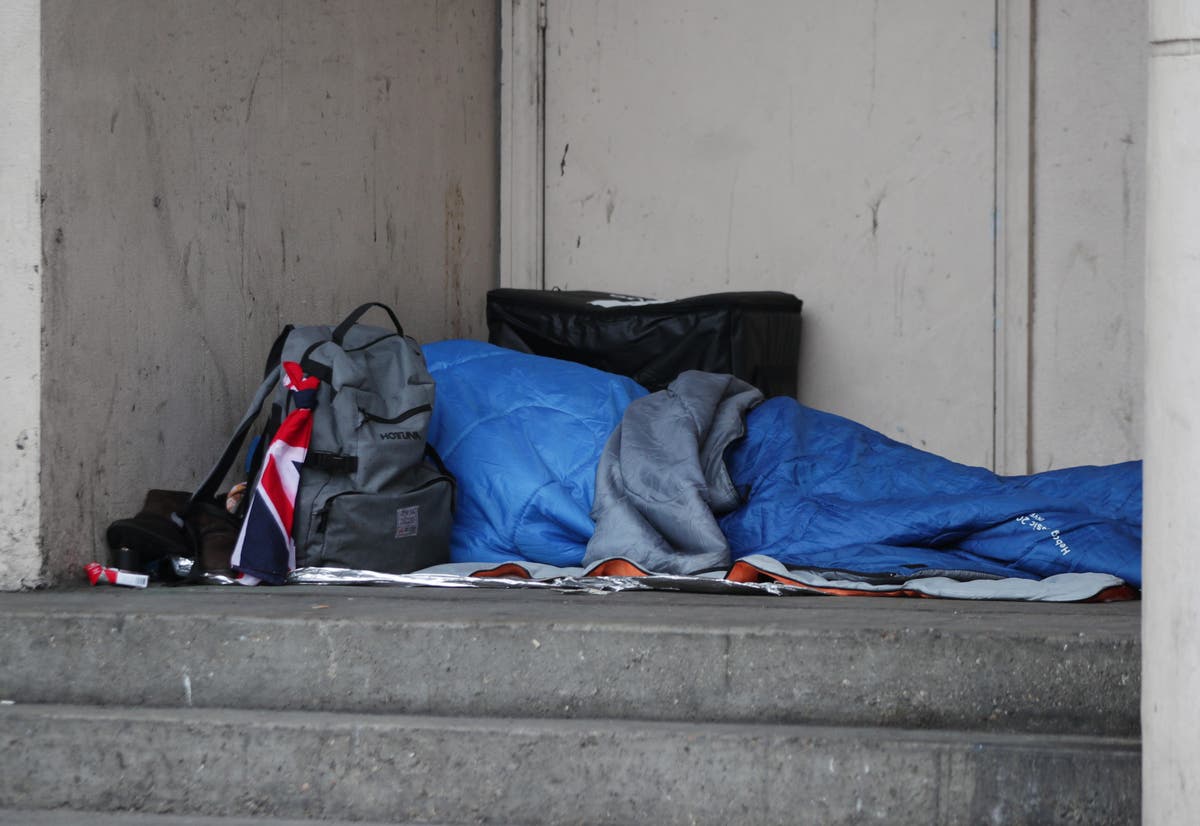
The number of people sleeping rough has soared by 27 per cent in a year with charities calling on politicians to act on “an escalating crisis”.
Over 100,000 households – two-thirds of which are families with children – are also living in temporary accommodation, government figures released on Thursday show.
Last year, 3,898 people were recorded as sleeping on the streets – an increase of almost a third on 2022’s figure, say the statistics. The government takes a snapshot of rough sleeping on a single night in autumn each year.
The latest figures are still less than the peak in 2017 but more than double the number of people who were sleeping rough in 2010, when records began.
The figure is also likely to be an underestimate as people sleeping in hidden or moving locations, such as on public transport, are likely to be missed, homelessness charities said.
The number of households living in temporary accommodation has also increased by 10.3 per cent year on year, to 109,000 in 2023.
Rough sleeping has more than doubled since 2010
(PA)
Data from the Department of Levelling Up showed that street homelessness is rising among women, with 568 recorded as rough sleeping last autumn up from 464 the year before. UK nationals remain the biggest proportion of people found to be sleeping rough at 62 per cent.
Labour’s shadow homelessness minister, Mike Amesbury, said that the latest data showed the “true human cost of the lack of social housing built by this government over the past 14 years.”
He added: “It is unacceptable to have over 142,000 children in temporary accommodation. We must get Britain building houses, hopes and dreams”.
Charities accused the government of allowing rough sleeping to “more than double on their watch”.
Polly Neate, chief executive of Shelter, said: “We haven’t built enough social homes in decades, and with rents at a record high, thousands of people are being forced to spend their nights freezing on street corners. Meanwhile families are being pushed into grim hostels and B&Bs miles away from their support networks and where children have to share beds.
Number of women rough sleeping has increased
(PA)
“Ignoring a crisis of this magnitude cannot continue”.
Matt Downie, chief executive at Crisis, said the scale of rough sleeping “is now a source of national shame”.
He added: “Through our frontline services we hear directly from people who have been spat at, urinated on or attacked simply because they do not have the security of a safe home. Things have got to change.
“To bring these numbers down, we urgently need the Westminster government to put long-term funding into the proven solutions we know help people to leave the streets behind, such as Housing First.”
Fiona Colley, at Homeless Link, said the data “points to a situation that is out of control and demands emergency action”.
The largest increase in the number of people estimated sleeping rough was in London, which saw an increase of 32 per cent in the past year.
A Department for Levelling Up, Housing and Communities spokesperson said they were spending £2.4bn to help people at risk of homelessness and support rough sleepers. They added: “Whilst we have made good progress and rough sleeping remains below pre-pandemic levels, there is more work to be done to meet our ambition to end it entirely and we will continue to work with local authorities to help people off the streets for good.
“Temporary accommodation is a vital safety net to make sure families are not left without a roof over their heads, but councils must make sure it is suitable for families.”