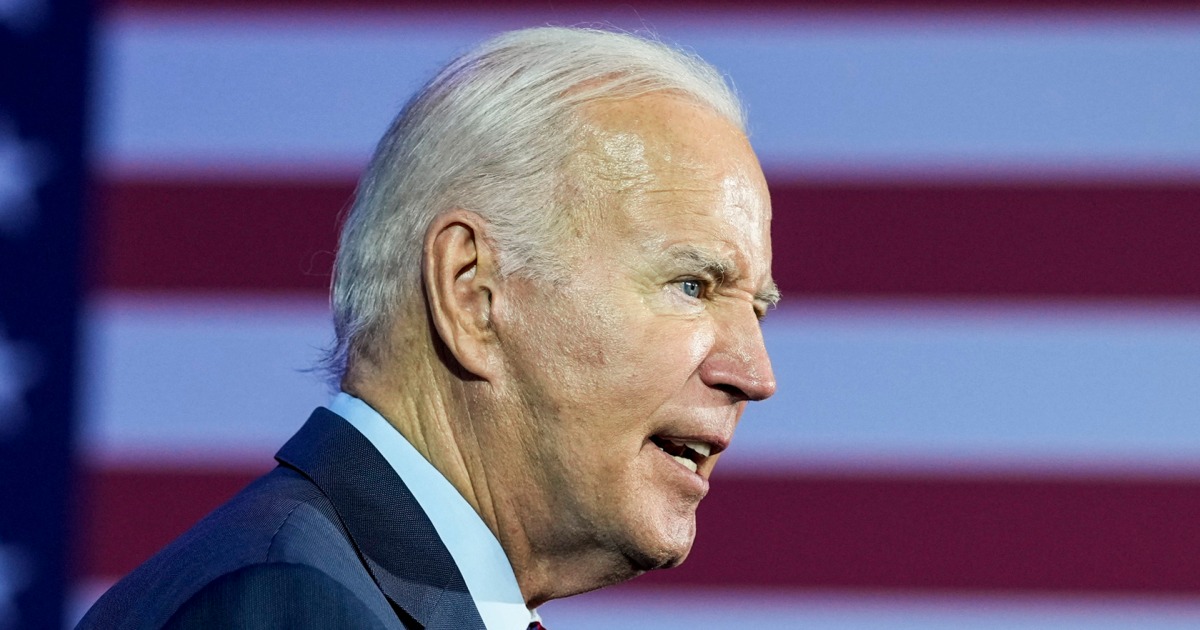
President Joe Biden on Wednesday touted his economic agenda amid low polling numbers on his job performance and the direction of the country.
In remarks delivered from Chicago’s Old Post Office building, Biden railed against the economic approach of his predecessor, President Donald Trump.
“The trickle-down approach failed the middle class. It failed America,” Biden said. “I knew we couldn’t go back to the same failed policies when I ran. So I came into office determined to change the economic direction of this country, to move from trickle-down economics to everyone at [the] Wall Street Journal and Financial Times began to call ‘Bidenomics.'”
“Guess what, Bidenomics is working. When I took office the pandemic is raging and our economy was reeling,” he continued. “Today, the U.S. has the highest economic growth rate, leading the world economies since the pandemic — the highest in the world.”
The president highlighted legislation he signed into law such as the Bipartisan Infrastructure Plan to repair and modernize the nation’s roads, bridges, transit systems and high-speed Internet.
He took credit for decreasing prices over the last year, saying, “Inflation is less than half of what it was a year ago.” Biden also noted that the Inflation Reduction Act that he signed into law has led to lower prescription drug costs.
The president touched on his proposal to overhaul the tax system, saying that he wants to increase rates on the highest earners, which he said would help reduce the deficit.
The president’s plan, which the White House has dubbed “Bidenomics,” aims to “move beyond” the “trickle down” economic theory that it says disproportionately benefits the wealthy and big corporations through tax cuts while reducing investment in priorities such as infrastructure and education, and failing to protect market competition.
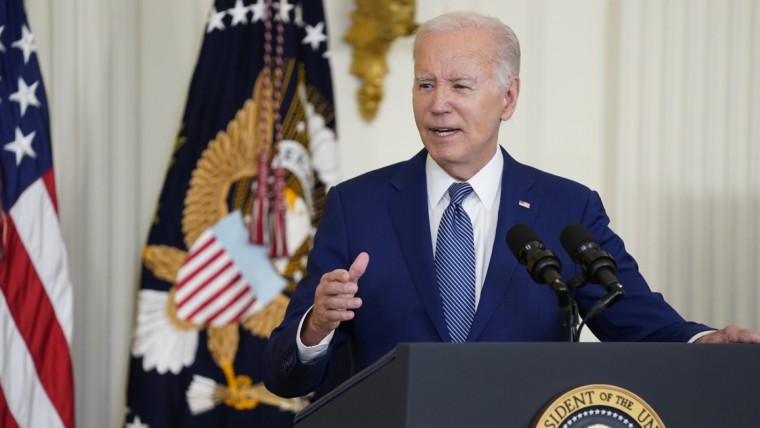
Core aspects of “Bidenomics” include targeted public investment to attract more private sector investment in sectors that are central to the country’s long-term economic and national security interests. That includes investments in infrastructure, semiconductors, clean energy and climate security. The White House cited the Bipartisan Infrastructure Law that the president signed in 2021, billions in private investment commitments since Biden entered office, an increase of inflation-adjusted manufacturing construction spending and the growth of the clean energy workforce last year.
The administration also seeks policies “designed to promote and empower workers,” noting record-low unemployment rates, including for women, minorities and disabled people. And it is touting its investments in apprenticeships and career technical education programs, support for labor unions, and push for free universal preschool and community college.
The plan supports “healthy competition across sectors,” the White House said, arguing that more competition results in lower costs for consumers and higher wages for workers.
The White House also criticized congressional Republicans for an economic approach that the administration argues would “harm hard-working families.” In recent months, Biden has highlighted Republican policies that he says would cause such harm, including rescinding IRS tax enforcement money, opposing his student loan forgiveness plan and potentially targeting entitlement programs — a criticism that Republican leaders pushed back against.
“President Biden believes in a fundamentally different approach,” the release said. “Under Bidenomics, he has proven that we can make smart investments in the American people while reducing the deficit by ensuring the wealthy and large corporations pay their fair share in taxes, closing wasteful tax loopholes, and slashing wasteful spending on special interests.”
In an interview with NBC News on Tuesday, Lael Brainard, the National Economic Council director, said Biden’s own middle-class roots, rather than any economic theory, drove the policy.
“The president really does think about a family sitting around a kitchen table at the end of the week, and thinking about whether they have breathing room and he often refers to his own experience,” Brained said. “His own experience in towns where a manufacturing plant might have shut down, where instead of leading to more investment in that town, tax cuts for big corporations actually didn’t preserve jobs.”
A recent NBC News poll found that only 20% of Americans think the country is headed in the right direction, while 74% believe it’s on the wrong track.
Pressed on how the president can argue “Bidenomics” is working despite his low polling numbers, Brainard acknowledged that there has been “a lot of consumer uncertainty” in recent years, but that Americans are beginning to see positive developments in the economy.
“Most American families experienced a lot of fundamental uncertainty and hardship during the pandemic. Then we saw energy prices spike due to Putin’s war,” Brainard said Tuesday. “So there’s been a lot of economic uncertainty. But if you look at the data that came out today, consumer confidence has actually increased to a level that we haven’t seen since January of 2022, before that invasion and oil price spikes.”
“So it is an economic reality that is positive — 13 million jobs created, unemployment below 4% for the longest stretch and 50 years,” she said. “So those good developments, people are starting to feel them and when they talk about their own personal financial circumstances, you can see that.”