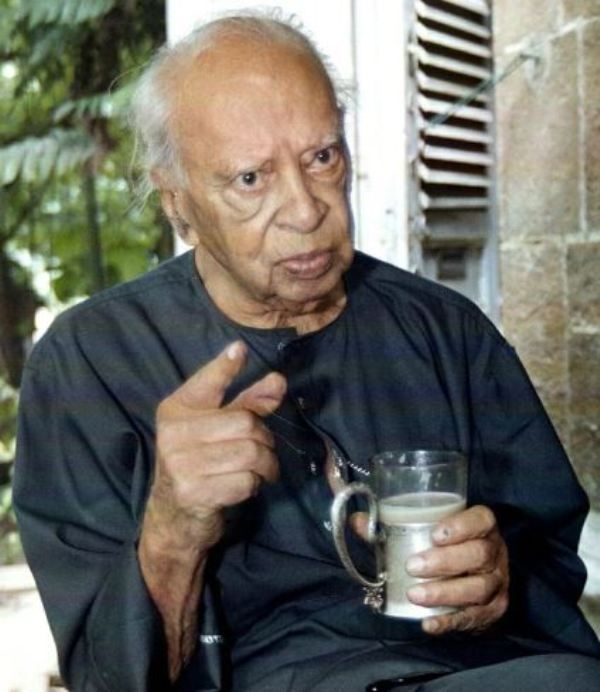
Mulk Raj Anand ( 1905-2004) was a prominent Indian writer, recognised for his realistic depiction of the poor castes in traditional India society through his writings. He is known as the father of Indian- English fiction. Mulk Raj Anand is commended for his novels and short-stories which are majorly based on themes like feudal system, poverty, hunger, religious hypocrisy and exploitation. Some of his prominent works include, Untouchable (1935), Coolie (1936), Across The Black Waters (1939), followed by other works such as the short story collection- The Lost Child and Other Stories (1934), The Tractor and the Corn Goddess and Other Stories (1947) and many more. In September 2004 he died due to pneumonia at the age of 98.
Wiki/Biography
Mulk Raj Anand was born on December 12, 1905 (age 98 years; at the time of death) in a Hindu Khatri family in Peshawar, British India (now in Khyber Pakhtunkhwa, Pakistan). His zodiac sign is saggittarius. He graduated in 1924 from Khalsa College, Amritsar. Later, he moved to England for further studies. There he gained his undergraduate degree from the University College, London. He further pursued PhD in Philosophy from Cambridge University in 1929. Mulk Raj Anand’s literary career began because of a family tragedy where his aunt was abandoned by the family just for sharing her food with a Muslim woman, due to which she commited suicide. This incident deeply affected Mulk Raj Anand. He understood the rigidity of Caste System in people’s mindsets. In response to it, Mulk Raj Anand wrote his first prose essay. In 1938, Mulk Raj Anand married an English actress Kathleen Van Gelder and had a daughter, Susheela. Shirin Vajifdar was his second wife who was an Indian classical dancer. In 1933, he returned to India and also lived in Sabarmati Ashram with Mahatma Gandhi and wrote his first draft of his first novel, Untouchable.
Mulk Raj Anand in his youth
Family & Caste
Mulk Raj Anand belonged to a Hindu Khatri family of Peshawar, British India.
Parents & Siblings
Mulk Raj Anand’s father, Lal Chand was a coppersmith who later joined the British Indian Army. His mother Ishwar Kaur was a farmer who belonged to a peasant family. They had five sons of whom four survived, Mulk Raj Anand was the third son.
Wife & Children
In 1938, Mulk Raj Anand married an English actress and communist Kathleen Van Gelder and had a daughter, Susheela. Later in 1948, both parted their ways after 10 years of being together. Shirin Vajifdar was his second wife who was an Indian classical dancer and a critic. They tied the knots in 1950.
Mulk Raj Anand’s second wife- Shirin Vajifdar
Religion/Religious Views
Although, Mulk Raj Anand belonged to a Hindu family, but his writings portray a beautiful presentation of his religious views. In the novel, Untouchable, Mulk Raj Anand has preached the religion of humanity based on Gandhi ji’s views over any other religion.
so that the kind of humanism, on which I believe the kind of world I hope for… is yet integral to the Indian tradition in which I grew up”
Signature/Autograph
Career
Mulk Raj Anand was a prolific writer . Besides novels and short stories, he had also written a number of books on art and paintings. He started the wave of social protest and realism in Indian English fiction through his works.
Novels
Untouchable 1935
Untouchable, Mulk Raj Anand’s first significant book, was released in 1935. The plot of the book follows a person from the lowest social caste in India. Untouchable is a strong work that exposes the dehumanizing differences and institutionalized oppressions present in India’s segmented society, despite its seeming simplicity. The protagonist of the book, Bakha, is brilliant and attractive but is an outcast who is prohibited from bettering his life because of the belief that his touch and presence are dirty and corrupting. Anand makes his case for untouchables’ education while criticizing the restrictions and laws that limit their existence by using Bakha’s tale as a springboard.
Coolie 1936
It is the second book written by Mulk Raj Anand The disparity in society between the affluent and the poor is depicted in Mulk Raj Anand’s Coolie, which also shows Munoo, a little kid from the hamlet of Bilaspur, living in abject poverty and leading a sad and pitiful existence. This is a tragedy for people brought on by poverty, being exploited, starvation, egotism, greed, and cruelty.
Across The Black Waters 1939
Anand wrote a triology between 1936 and 1941 – The Village (1939), Across the Black Waters (1940) and The Sword and the Sickle (1942). Across the Black Waters recounts Lalu’s experience serving as a sepoy in the Indian Army through World War I as he fought for Britain against the Germans in France. He is presented by the author as a peasant who was forcibly removed from his family’s farm and has a hazy understanding of the nature of the conflict.
Other Novels
Two Leaves and a Bud (1937); The Village (1939); Lament on the Death of a Master of Arts (1939); The Sword and the Sickle (1942); The Big Heart (1945); Seven Summers: the Story of an Indian Childhood (1951); The Private Life of an Indian Prince (1953); The Old Woman and the Cow (1960)
Short-Story Collections
Old Bapu (The Power of Darkness and Other Stories collection)
Mulk Raj Anand have used the theme of mortality, struggle and hope in Old Bapu, taken from his The Power of Darkness and Other Stories collection. The story is narrated by an unnamed narrator in third person perspective.
The Silver Bangles (Lajwanti and Other Stories collection)
This story is a part of Lajwanti and Other Stories collection written by Mulk Raj Anand. The themes that he has used in it are patriarchy, hatred and rage. Again, the narrator of this story is unknown and is written through a third person’s perspective.
Other Short story collections
The Lost Child and Other Stories (1934); The Barber’s Trade Union and Other Stories (1944); The Tractor and the Corn Goddess and Other Stories (1947); Reflections on the Golden Bed and Other Stories (1953); Between Tears and Laughter (1973)
Books on Art and Paintings
Album of Indian Paintings (1973);(1984);
Controversy
Mulk Raj Anand was once mocked and criticised for writing a novel (Untouchable 1935) about a lower-caste by an English critic Edward Sackville-West, a novelist and a music critic who in the 1920s and 1930s, wrote a series of semi-autobiographical novels.
He said superciliously, ‘Oh! There can be no novel about the poor! One can only laugh at the Cockneys like Dickens’. This unnerved me and made me feel hopeless about my confessional,” said Mulk Raj Anand.
Awards, Honours, Achievements
- Sahitya Akademi Award (1971)
- International Peace Prize (1953)
Net Worth
Mulk Raj Anand’s net worth is estimated to be $1 million to $2 million dollars in his primary career as a Writer.
Death
Mulk Raj Anand was suffering through pnemonia and died at Jehandir hospital in Pune on 28 September, 2004 at the age 98.
Facts/Trivia
- M. K. Naik, scholar of Indian literature in English compared Mulk Raj Anand to an “august and many-branched” banyan tree.
- Mulk Raj Anand was an active member of the Indian National Congress.
- He was also a member of the British Labor Party.
- During World War ll, Mulk Raj Anand was a scriptwriter in the BBC London film division. He also worked as a broadcaster in the same film division.