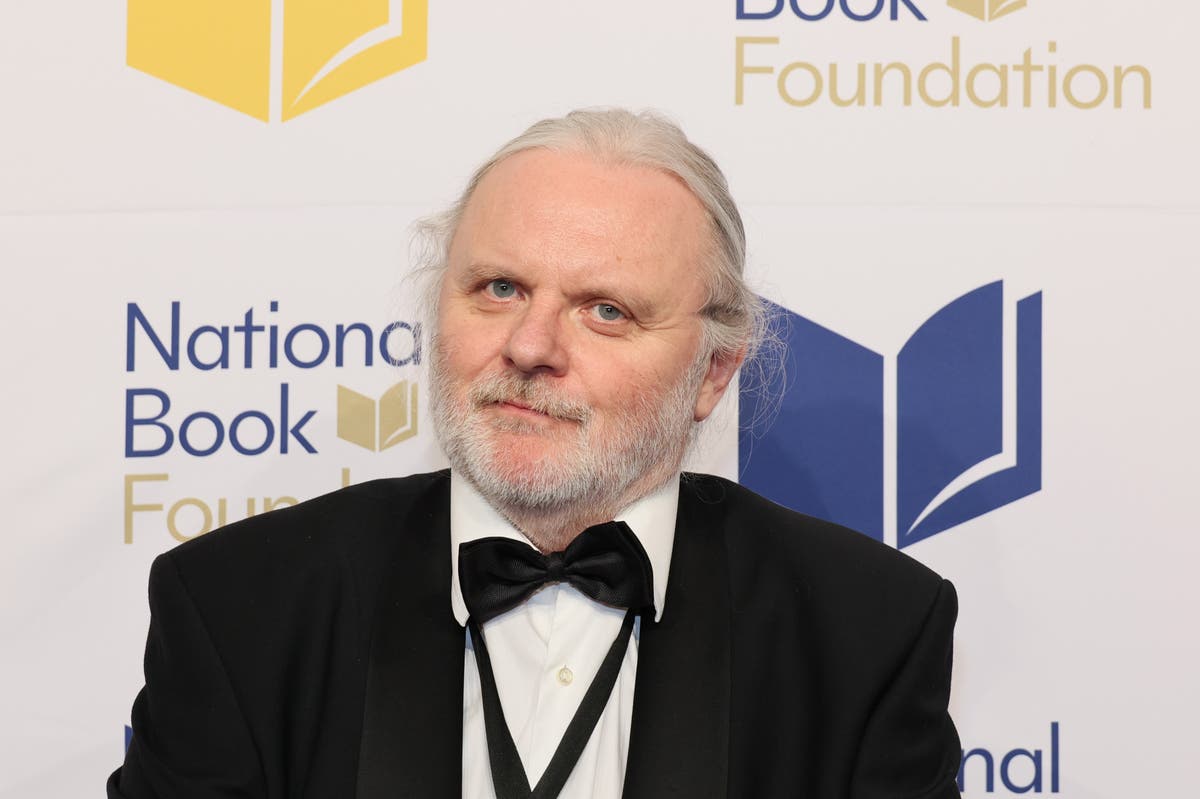
Norwegian author and playwright Jon Fosse has been awarded the 2023 Nobel Prize in Literature.
The author was announced as the winner in a ceremony at the Swedish Academy in Stockholm on Thursday (6 October), which was also livestreamed online.
The prize consists of a gold medal, diploma and cash sum, and is awarded each year to “to the person who, in the field of literature, produced the most outstanding work in an idealistic direction”. The value of the monetary prize changes from year to year, based on the Nobel Foundation’s finances.
Fosse was informed of the win via telephone. “Not every laureate believes me when I make the call,” the announcer said, “but he was prepared to have confidence until one o’clock. He was driving in the countryside in Norway, and we had the opportunity to start speaking about practical matters for the Nobel week in December.”
Over the course of his career, Fosse, 64, had written more than 40 acclaimed works. While his early work was often best known within continental Europe, he has enjoyed a blossoming reputation in English-speaking countries in recent years.
His 2022 novel A New Name: Septology VI-VII, translated into English by Damion Searls, was shortlisted for the International Booker Prize.
The work concluded a three-book septology that has been described as his “magnum opus” in prose, and takes the form of a lengthy monologue in which an elderly artist speaks to himself as another person.
Fosse said that he was “overwhelmed and somewhat frightened” at receiving the award.
A spokesperson for the Nobel committee said: “[Fosse’s] immense oeuvre, written in Norwegian Nynorsk and spanning a variety of genres, consists of a wealth of plays, novels, poetry collections, essays, children’s books and translations. While he is today one of the most widely performed playwrights in the world, he has also become increasingly recognised for his prose.”
While nominees are not announced in advance – in fact, the full nominees list is not revealed to the public until 50 years have passed – this year’s frontrunners had been tipped to include British-Indian novelist Salman Rushdie, 76, Canadian writer Margaret Atwood, 83, Japan’s Haruki Murakami, 74, Chinese writer Can Xue, 70, and Romania’s Mircea Cartarescu, 67.
Last year, the prize was given to French author Annie Ernaux, known for writing La Place and Les Années.
Futher contextualising Fosse’s win on social media, the Nobel organisation wrote: “Jon Fosse – awarded the 2023 #NobelPrize in Literature – has much in common with his great precursor in Norwegian Nynorsk literature Tarjei Vesaas. Fosse combines strong local ties, both linguistic and geographic, with modernist artistic techniques.
“He includes in his Wahlverwandschaften such names as Samuel Beckett, Thomas Bernhard and Georg Trakl. While Fosse shares the negative outlook of his predecessors, his particular gnostic vision cannot be said to result in a nihilistic contempt of the world. Indeed, there is great warmth and humour in his work, and a naïve vulnerability to his stark images of human experience.”
The announcement comes amid a week of other Nobel announcements. On Monday (2 October), the Nobel Prize in Physiology or Medicine was awarded to Katalin Kariko (Hungary) and Drew Weissman (US) for their work that led to the development of the first mRNA Covid vaccines.
Tuesday saw the Physics prize go to Pierre Agostini, Ferenc Krausz and Anne L’Huillier, who collectively made breakthroughs in “experimental methods that generate attosecond pulses of light for the study of electron dynamics in matter”.
The Nobel Prize in Chemistry was awarded the followig day to scientists Moungi Bawendi, Louis Brus and Alexei Ekimov “for the discovery and synthesis of quantum dots”, which have applications in computer technology and healthcare. The news was, however, announced early in a rare blunder for the organisation.