Flashpoints | Security | Southeast Asia
The Philippines’ bold and creative moves to defy China provide a powerful example to the other Southeast Asian nations on how they, too, can resist Chinese interference.
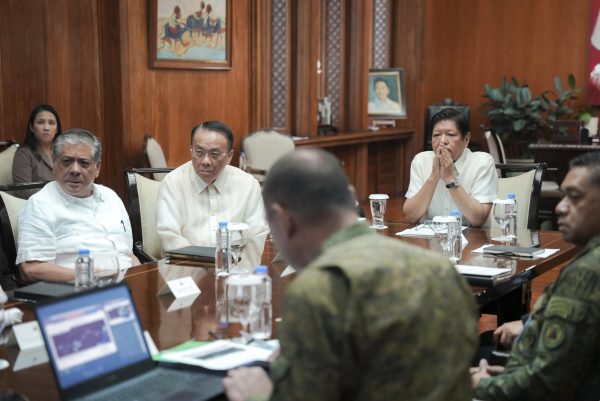
In this handout photo provided by the Malacanang Presidential Communications Office, Philippine President Ferdinand Marcos Jr., center right, listens during an emergency meeting with the defense secretary and other top military and security officials to discuss the latest hostilities in the disputed South China Sea at the Malacanang presidential palace in Manila, Philippines on Oct. 23, 2023
Credit: Malacanang Presidential Communications Office via AP
China has long pursued its illegal and expansive maritime claims through “gray zone” tactics – coercive behavior that is aimed at changing the status quo but that is below a threshold that would prompt a military response. More recently, the focus of its maritime bullying has been the Philippines, which in the last nine months has faced Chinese military-grade lasers and water cannons aimed at preventing it from resupplying an outpost in the disputed Spratly Islands.
Manila, however, is standing up to Beijing’ s maritime aggression. Two weeks ago, Manila took a page out of the Chinese playbook and disguised Coast Guard officials as fishermen. They removed a string of buoys blocking Filipino fishermen from accessing waters in their own exclusive economic zone (EEZ) near the Scarborough Shoal. The symbolic display of resistance was important because it exposed China’s bullying tactics and demonstrated to other nations that face similar Chinese intimidation that there are ways to push back.
Beijing is seeking to force Manila to give up its claim to Second Thomas Shoal, a submerged reef in the disputed Spratly Islands. For nearly a quarter of a century the Philippines has maintained a small marine force on an abandoned ship (the Sierra Madre) on the reef to stake its claim to the area. In February, the Chinese Coast Guard harassed a Philippine vessel seeking to resupply the marines by training a military-grade laser on it, temporarily blinding the crew. In August, China again sought to prevent the Philippine Coast Guard from resupplying the Sierra Madre by firing water cannons at a Philippine vessel. And last weekend, a Chinese Coast Guard vessel attempted to block a Philippine supply boat on its way to the Sierra Madre, resulting in a collision.
Philippines President Ferdinand Marcos Jr. has been clear since taking power 18 months ago that he will stand up for Philippine sovereignty. Shortly after his election, Marcos issued a statement indicating his government would rely on the 2016 international arbitral ruling against China’s expansive maritime claims to 90 percent of the South China Sea. This marked a change. His predecessor, Rodrigo Duterte, in an effort to court China, had failed to stand behind the 2016 arbitral decision.
Diplomat Brief
Weekly Newsletter
Get briefed on the story of the week, and developing stories to watch across the Asia-Pacific.
Get the Newsletter
Duterte’s passive stance carried consequences. In the spring of 2021, China deployed a “maritime militia,” consisting of around 200 vessels disguised as fishing boats, around another maritime feature in the Spratly Islands called Whitsun Reef. The Philippines filed a diplomatic protest, claiming the Chinese had deployed the swarm of boats in preparation for taking control of the reef, and eventually China removed the boats. Duterte was chastened by the Whitsun Reef episode, and it likely contributed to his decision to finally renew the Philippines’ Visiting Forces Agreement with the United States in the summer of 2021.
Marcos also has been buoyed by the strong commitment the Biden administration has made to strengthening the Philippines-U.S. alliance. In April nearly 18,000 U.S. and Philippines troops took part in the annual Balikatan (“shoulder-to-shoulder”) military exercise – double the number of forces that normally participate. A few weeks later, Marcos held bilateral talks with U.S. President Joe Biden in May at the White House, where they announced the adoption of Bilateral Defense Guidelines to deepen alliance cooperation. The guidelines reaffirm that an attack on any public Philippine vessel in the Pacific Ocean, including the Coast Guard, would invoke mutual defense commitments of their 1951 Mutual Defense Treaty.
This progress followed a Philippine decision earlier this year to open four additional military sites for U.S. access, including in Northern Luzon province, 150 miles from Taiwan. These will supplement the five bases to which the United States already has access through the Enhanced Defense Cooperation Agreement (EDCA).
Other nations such as Japan, Australia, and Canada also are showing solidarity with the Philippines. Tokyo recently prioritized improving defense ties with Manila and even landed two F-15 fighter jets, a refueling aircraft, and a transport plane at Clark Air Base in northern Philippines last December. Canada carried out a joint patrol with the Philippines in the South China Sea last month, while Australian Prime Minister Anthony Albanese pledged to do the same during a recent visit to Manila.
Advertisement
China’s most aggressive maritime moves are currently aimed at the Philippines, but Vietnam, Indonesia, and Malaysia have also faced China’s maritime bullying in the form of the Chinese Coast Guard ramming fishing vessels, seeking to prevent oil and gas exploration, and surveying their EEZs.
The Philippines’ bold and creative moves to defy China provide a powerful example to the other Southeast Asian nations on how they, too, can resist Chinese efforts to violate their sovereignty and access to crucial resources and livelihoods. While it may seem like a minor action, the Philippines’ removal of a small set of buoys in the South China Sea helps puncture China’s narrative and expose its bullying tactics and reshape the information environment in favor of protecting nations’ sovereignty.