
Sign up for the daily Inside Washington email for exclusive US coverage and analysis sent to your inbox
Get our free Inside Washington email
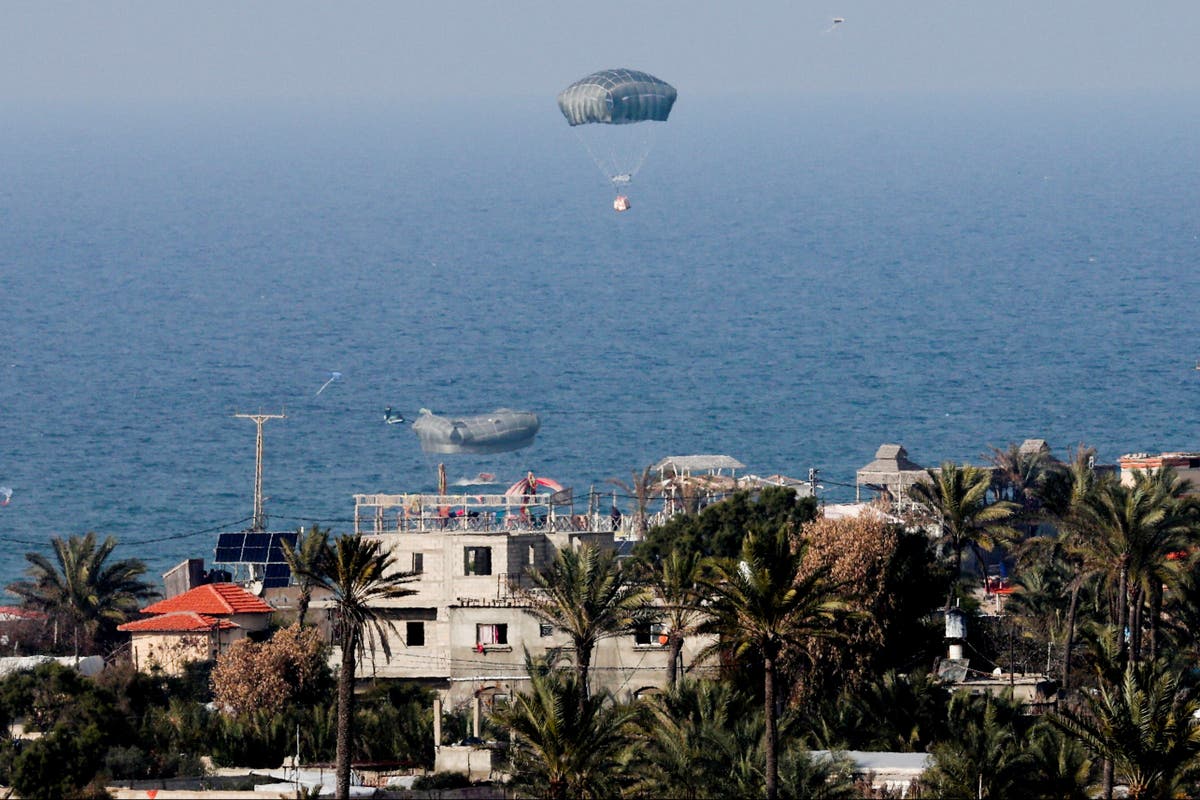
The White House is said to be considering airdropping aid from US military planes into Gaza amid dire warnings of famine in the territory and following the failure of US officials to convince Israel to allow sufficient aid deliveries on the ground.
Jeremy Konyndyk, who led USAID’s Office of Foreign Disaster Assistance during the Obama administration and oversaw humanitarian air drops to Nepal, the Philippines and Iraq, described the potential plan as “major policy failure.”
“When the US government has to use tactics that it otherwise used to circumvent the Soviets and Berlin and circumvent Isis in Syria and Iraq, that should prompt some really hard questions about the state of US policy,” he told The Independent.
US officials told Axios that the US was considering the plan due to the inability of humanitarian groups to reach northern Gaza due to “the security situation and the Israeli restrictions.”
The move follows months of warnings from aid groups that Israel’s war in Gaza is causing a humanitarian catastrophe on a scale that would be impossible to contain.
The United Nations warned this week that some 576,000 people, or one quarter of Gaza’s population, are “one step away from famine.” It has also accused Israel of “systematically” blocking aid deliveries into Gaza and of opening fire on convoys that do make it through.
The US has repeatedly said it has been working behind the scenes to convince Israel to allow more aid into Gaza, but the Biden administration has pointedly refused to condition billions of dollars of aid it gives to Israel each year as leverage to pressure its ally to do so. The result is that the amount of aid that has reached Gazans dropped by half in February.
The dire conditions on the ground in Gaza were drawn into sharp relief on Thursday when more than 100 Palestinians were killed after Israeli forces opened fire on a crowd that was scrambling to collect aid from food trucks near Gaza City. The Israeli army said its forces had “fired at those who posed a threat” after some civilians rushed towards the trucks.
Former Obama official Mr Konyndyk, who is now president of Refugees International, told The Independent airdrops are “the most expensive and least effective way to get aid to a population. We almost never did it because it is such an in extremis tool.”
Mr Konyndyk referenced his experience managing US airdrops to Yazidi civilians who were fleeing attacks from Isis fighters on the top of Mount Sinjar in northern Iraq in 2014. At the same time it was dropping aid, the US was also carrying out airstrikes against Isis fighters who were besieging those receiving it.
“We coordinated US military aid airdrops to that population while they were sheltering on the mountain. We had to do that because they were being besieged by a terrorist group […] So when we see this happening in a place that is under the military control of an ally of the United States, it’s just a shocking thing to see,” he said.
“Israeli military tactics here are functionally the equivalent of an earthquake in Nepal in terms of the impact they’re having on humanitarian access. That’s a policy choice,” he said. “And it’s totally inexcusable that governments, including potentially the US government, are resorting to airdrops because Israel won’t allow consistent humanitarian access and won’t open the border crossings.”
The State Department did not respond to a request for comment.