
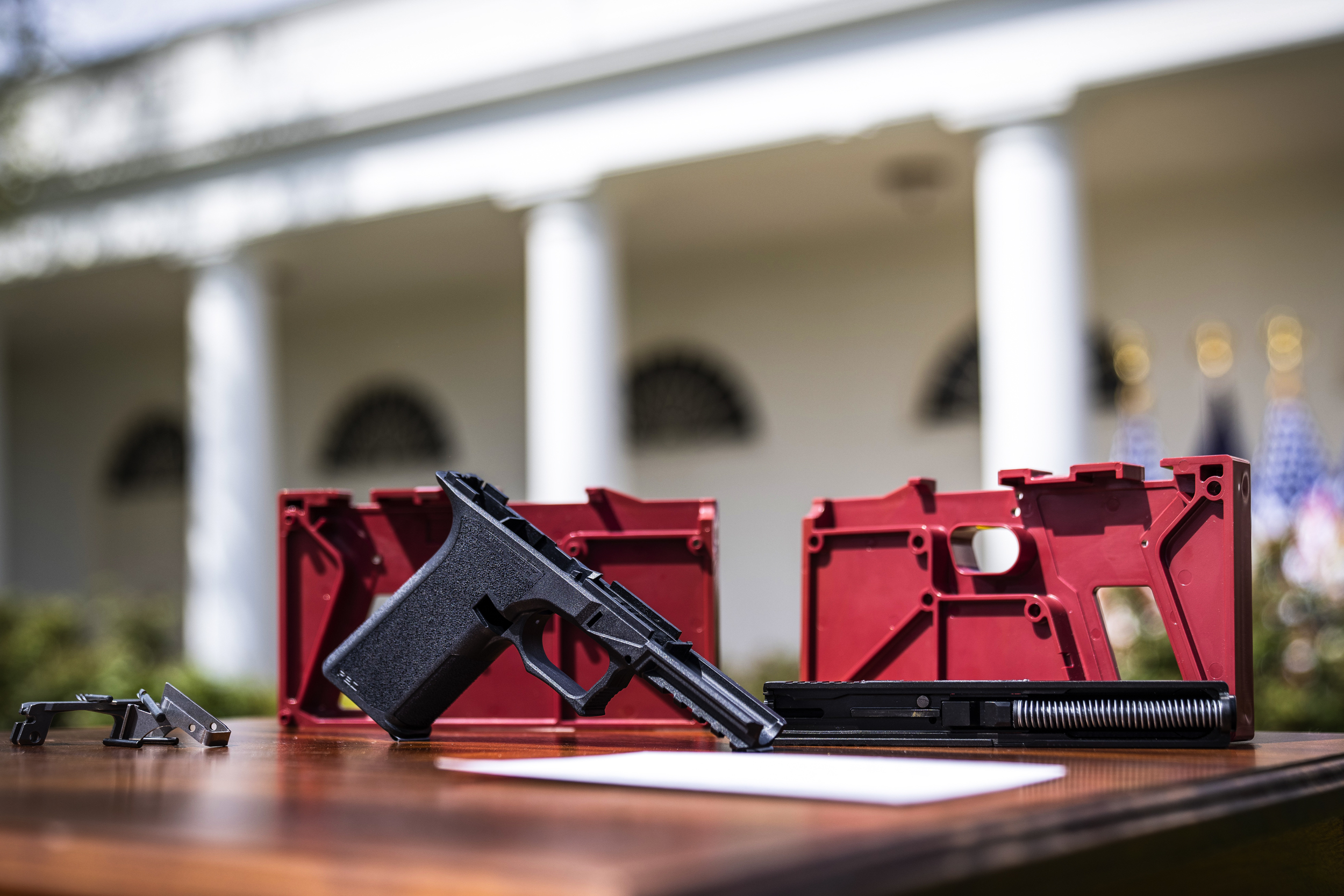
WASHINGTON — A divided Supreme Court on Tuesday allowed the Biden administration to enforce regulations aimed at clamping down on so-called ghost guns — firearm-making kits available online that people can assemble at home.
The court in a brief order put on hold a July 5 ruling by a federal judge in Texas that blocked the regulations nationwide.
The vote was 5-4, with conservatives Chief Justice John Roberts and Justice Amy Coney Barrett joining the three liberal justices in the majority.
The federal Bureau of Alcohol, Tobacco, Firearms and Explosives, commonly known as ATF, issued the regulations last year to tackle what it claims has been an abrupt increase in the availability of ghost guns. The guns are difficult for law enforcement to trace, with the administration calling them a major threat to public safety.
The rule clarified that ghost guns fit within the definition of “firearm” under federal law, meaning that the government has the power to regulate them in the same way it regulates firearms manufactured and sold through the traditional process.
The regulations require manufacturers and sellers of the kits to obtain licenses, mark the products with serial numbers, conduct background checks and maintain records.
Gun control groups welcomed the decision from a court that frequently backs gun rights.
“Americans across the country will be safer thanks to the Supreme Court’s decision today to keep ATF’s life-saving ghost guns rule in effect while the appeals process plays out,” said John Feinblatt, president of the group Everytown for Gun Safety.
Manufacturers and sellers have challenged the regulations in court, with two federal judges ruling in favor of the government.
But in Texas, Judge Reed O’Connor came to the opposite conclusion in a case brought by Jennifer VanDerStok and Michael Andren, people who own components that they want to use to build guns. Plaintiffs also include gun rights groups and makers and sellers of ghost guns.
David Thompson, a lawyer for some of the challengers, said he remained confident that “we will ultimately prevail on the merits” once the litigation concludes.
Tuesday’s ruling was not a final decision and the Supreme Court could still hear the case and issue a detailed decision on the merits. The vote breakdown on Tuesday does not necessarily reflect how the justices would vote in that scenario.
An ATF spokesman said the agency does not comment on ongoing litigation.
Solicitor General Elizabeth Prelogar, representing the Biden administration, wrote in court papers that O’Connor’s ruling harmed the public by “reopening the floodgates to the tide of untraceable ghost guns flowing into our nation’s communities.”
Lawyers for the challengers wrote in response that the Gun Control Act of 1968 only regulates the commercial market for firearms, “leaving the law-abiding citizens of this country free to exercise their right to make firearms for their own use without overbearing federal regulation.”
The administration quickly turned to the New Orleans-based 5th U.S. Circuit Court of Appeals, which declined to block the majority of O’Connor’s decision.
On July 28, Justice Samuel Alito temporarily put the Texas ruling on hold while the Supreme Court decided on what next steps to take.
The Supreme Court’s conservative majority has backed gun rights in multiple cases, including the landmark 2022 ruling that for the first time recognized that the Constitution’s Second Amendment includes a right to bear arms outside the home.
In the court’s coming term, which starts in October, the court will weigh the scope of that decision in a case concerning whether people accused of domestic violence have a right to own firearms.
The ghost guns case, however, is on a separate legal question related to ATF’s regulatory authority, not the right to bear arms.