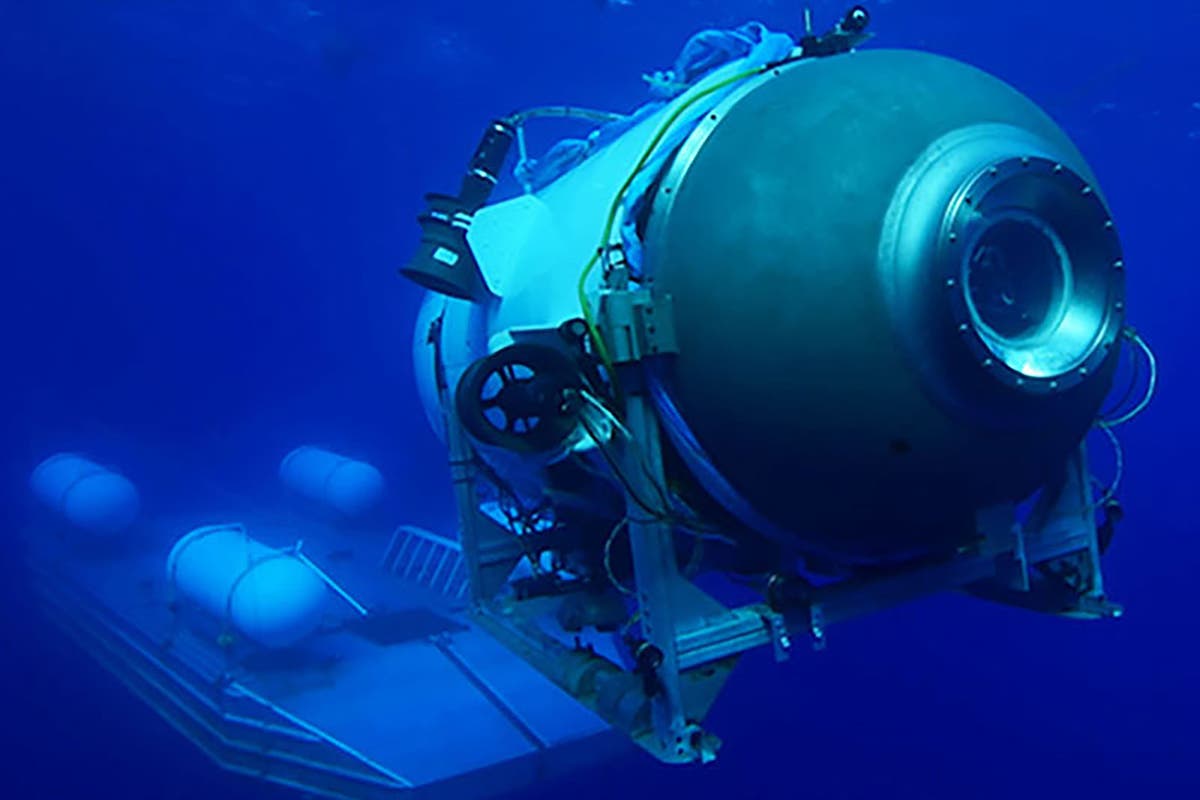
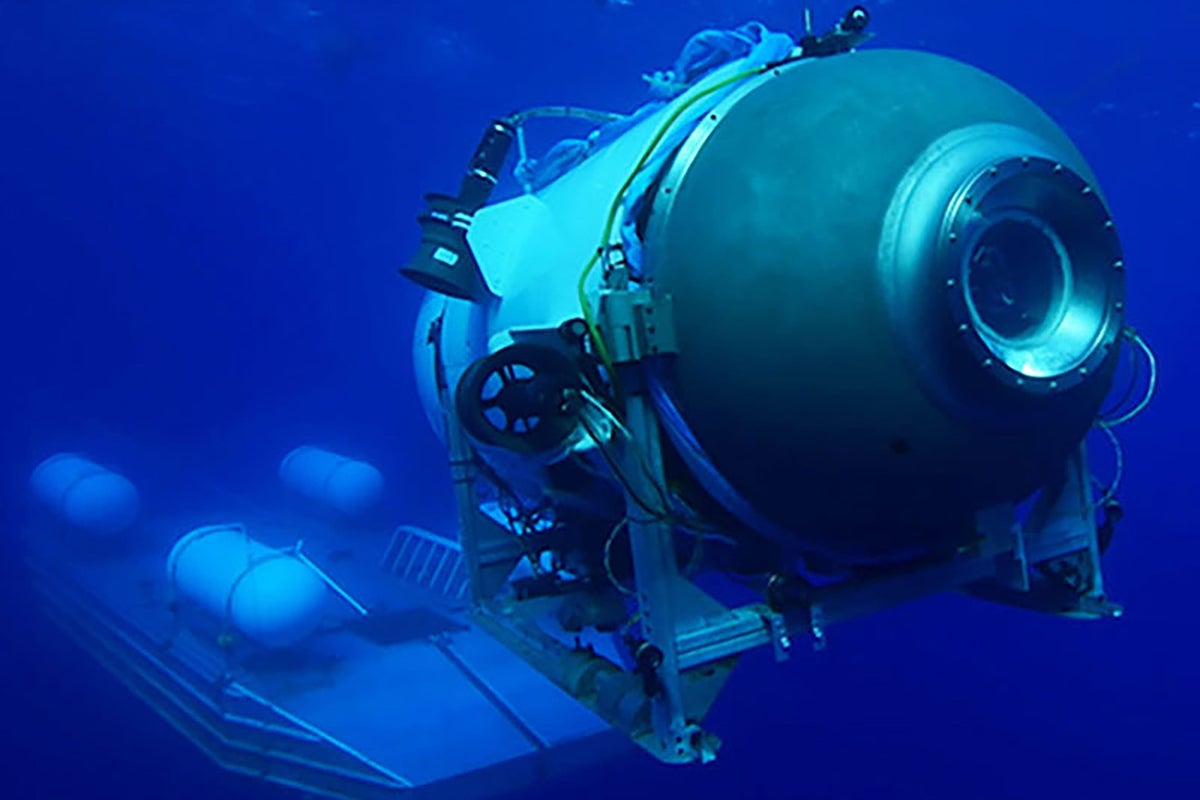
A debris field was discovered within the missing Titan submersible search area near the Titanic by a remote operated vehicle, officials say.
Experts within the search and rescue mission’s unified command are evaluating the information, the US Coast Guard’s Northeast command said.
It is unclear whether the debris was connected to the search for the Titan. The US Coast Guard has scheduled a press conference for 3pm EST.
The discovery is the first possible sign of the Titan submersible since it vanished about 105 minutes after launching from the Polar Prince icebreaker research ship about 900 miles off the coast of Cape Cod on Sunday morning.
The debris field was reportedly found on the seabed floor close to the famous shipwreck site at a depth of about 4,000m by a Horizon Arctics’ remote operated vehicle (ROV).
CEO and founder of OceanGate Expeditions Stockton Rush, British billionaire explorer Hamish Harding, renowned French diver Paul-Henri Nargeolet and Pakistani businessman Shahzada Dawood and his 19-year-old son Suleman Dawood were aboard the vessel when it lost communications on Sunday.
A sweeping search effort involving Canadian Boeing P-8 Poseidon and C-130 Hercules reconnaissance aircraft, 10 vessels and underwater sonar buoys had been combing an area of the North Atlantic Ocean twice the size of Connecticut for the past several days.
The search teams had been racing to find the Titan before a 96-hour deadline passed on Thursday morning when the vessel’s oxygen reserves were expected to extinguish.
A debris field was discovered within the search area by an ROV near the Titanic. Experts within the unified command are evaluating the information. 1/2
— USCGNortheast (@USCGNortheast) June 22, 2023
The Titan vanished around 105 minutes into its 4,000m dive on Sunday morning when its twin communication systems of texts and pings stopped suddenly.
David Pogue, who travelled to the famous wreck site on board the Titan in 2022, told CBC earlier this week there were likely only two possible explanations.
“Either they lost all power or the ship developed a hull breach and it imploded instantly. Both of those are devastatingly hopeless,” Mr Pogue said on Tuesday.
Five people are missing aboard the Titan: Clockwise from top left Hamish Harding, Stockton Rush, Shahzada and Suleman Dawood, and Paul-Henri Nargeolet
(Dirty Dozen Productions/OceanGate/AFP/Getty)
A rescue mission at such extreme depths has never been carried out before, and there was no blueprint from which the US Coast Guard leading the search could work with.
Lacking the specialist remote operated vehicles (ROVs) necessary to operate at the Titanic shipwreck’s location, officials had to coordinate a multi-national response at breakneck speed involving private companies from at least six countries.
ROVs capable of reaching the 4,000m depth which the Titanic shipwreck sits at arrived at the search site on Wednesday.
The US Coast Guard insisted on Wednesday that the operation remained “100 per cent” a search and rescue operation, rather than a recovery.
In the days since the vessel disappeared, stories of whistleblower warnings, “experimental” building techniques and faulty communication systems on the OceanGate Expeditions vessel have emerged.
Mr Rush, the founder and CEO of OceanGate, had been on many of the Titan’s 13 previous trips to the famed shipwreck, and insisted the submersible was safe in interviews.
The Titan had seven on board mechanisms to resurface in the event of an emergency.
They included thrusters, an inflatable air bladder, and “drop weights” of sandbags and lead pipes that would fall off in the event of an emergency and bring the vessel up to the surface using buoyancy.
If the crew was incapacitated, hooks holding the sandbags were designed to dissolve in sea water. It’s unclear if any of these safety measures were activated.