
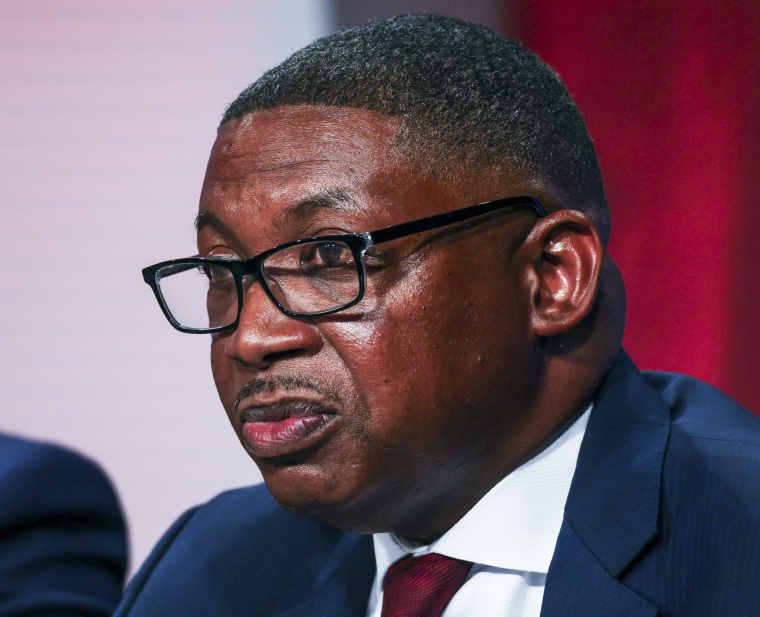
Democrat Shawn Wilson was asked at a recent Louisiana governor’s debate why the term “pro-life” had disappeared from his campaign website.
Wilson said he and his family “have chosen a certain path in life. It is not my place as governor to make those type of health care decisions for themselves or for other women in those positions.”
The removal of those eight characters is no minor website edit — it demonstrates just how quickly the political ground has shifted on abortion in the 15 months since the Supreme Court overturned Roe v. Wade, a nearly 50-year precedent protecting the federal right to an abortion.
Four years ago, Louisiana Democratic Gov. John Bel Edwards was re-elected while claiming the “pro-life” mantle. Today, as abortion bans in red states have become reality, red-state Democrats are trying to run by painting Republicans as extreme on the issue and focusing on supporting exceptions to bans in cases of rape, incest and when the mother’s life is at risk.
But Democrats are still figuring out exactly how, and how often, to talk about abortion in these GOP-leaning states, where they need to win over conservative voters but also turn out as many Democrats as possible to prevail. It’s a tricky dynamic in the post-Roe era as these Democrats try to show independence from their own party while taking advantage of an opening to criticize Republicans on an issue that cuts across some party lines.
This year’s governor’s races in Louisiana, Kentucky and Mississippi will test three different approaches to that balancing act.
In Kentucky, Democratic Gov. Andy Beshear is leaning into the issue, launching two TV ads in recent weeks targeting GOP Attorney General Daniel Cameron’s past support for the state’s no-exception ban on abortion.
In Mississippi, Democratic Public Service Commissioner Brandon Presley said, “I’m pro-life,” directly into the camera in one recent TV ad, and has focused his campaign’s energy and money on other issues like Medicaid expansion and a welfare fraud scandal plaguing GOP Gov. Tate Reeves.
And in Louisiana, Wilson, the former Secretary of the Louisiana Department of Transportation and Development, is somewhere in the middle. Wilson is personally “pro-life,” and he has also said a woman’s health care decisions are between her and her doctor, not the government. But Wilson did not address the abortion issue in his first TV ad of the race. Wilson, who is running to replace term-limited Bel Edwards, also still has to advance as one of the top two finishers in the state’s Oct. 14 primary for a chance at the governorship.
“There’s no one-size-fits-all on how to talk about this issue,” said Democratic pollster Margie Omero, who is not involved in any of the gubernatorial races.
“And governors in particular, gubernatorial candidates, are successful when they reflect the abortion views of the people in their state,” she added.
There could be a few reasons why Beshear is leaning more into abortion than Wilson and Presley. Along with more campaign cash and the power of incumbency, Beshear also has proof that Kentucky voters can be animated by abortion.
Last year, 52% of Kentucky voters rejected a ballot initiative that would have amended the state constitution to say that Kentuckians do not have a right to an abortion, defeating it by nearly five percentage points.
”We saw that you could win on abortion,” said Tamarra Wieder, Kentucky State Director for Planned Parenthood Action Kentucky, which has launched digital ads and a field program to boost Beshear. Wieder noted that voters of all political stripes are “feeling that impact” of the state’s near-total ban.
Alex Floyd, a Beshear campaign spokesman, pointed to the ballot initiative in a statement to NBC News about the campaign’s recent focus on abortion.
“Daniel Cameron supports an extreme ban with no exceptions for rape or incest — and has defended it in debates, surveys, interviews and to the Kentucky Supreme Court,” Floyd said. “Kentuckians rejected this extremism at the ballot box last November and they will again in this election.”
Cameron had previously pledged to support the state’s abortion, which does not include exceptions for rape and incest, “as is,” but he reversed his position last week, per the Lexington Herald Leader. Cameron’s comments came after Beshear launched a TV ad featuring a young woman saying Cameron’s support for the current ban would leave no options for girls like herself, saying she was raped by her stepfather at age 12.
“I’ve said if the legislature were to bring me a bill with exceptions, I would sign it,” Cameron said in a video responding to the ad, calling the ad campaign “despicable.”
Cameron later said that he meant he would sign a bill if a court mandated that the state add exceptions, noting “it wouldn’t be me, proactively,” per the Associated Press.
Beshear and his allies are running on other issues, too, but Wieder said the recent focus on abortion is a shift for Democrats in Kentucky.
”It has been a struggle to get candidates across the commonwealth to talk about abortion,” Wieder noted. “This is, I think, the real turning point. Roe was the real turning point.”
Mark Riddle, a Kentucky-based Democratic strategist who is not involved in the race, said focusing on abortion is a smart move, even in a culturally conservative state.
“For a Democrat to win in places like Kentucky you need to get younger voters out to vote, a certain percentage of suburban women voters to vote,” Riddle said. “And this is a core issue to both of those constituencies.”
Unlike Beshear in Kentucky, who has won before and has the best chance of winning again this fall, Wilson and Presley are still introducing themselves to voters. And that involves creating some distance with national Democrats.
“The pro-life label, along with the pro-gun label, along with standing up for law enforcement in a responsible way, are potentially important signals that Democrats can send in Southern states, in Western states, in more conservative-oriented states that demonstrate a given Democratic candidate is cut from a different cloth of the national party,” said Zac McCrary, a Democratic pollster working with the Wilson and Presley campaigns.
”It becomes imperative for a Democratic candidate to demonstrate that there is something different about them,” McCrary said
Presley has said he supports the current law in Mississippi “as is,” which bars most abortions but does include exceptions for protecting the mother’s life and in cases of rape.
“Being pro-life is more than just the abortion issue. Look, I’m pro-hospital. I’m pro-doctor. I’m pro-ambulance. I’m pro-emergency room.” Presley told WJTV 12 News in June.
But Democrats watching the Mississippi race say expanding Medicaid access is a far more salient issue than abortion.
Andre Wagner, the executive director of the Mississippi Democratic Party, said health care was the top issue for voters as he knocked on doors over the weekend for the Presley campaign, noting, “In Mississippi the conversation is simply about Medicaid, expanding health care coverage.”
But recent elections in Wisconsin and Ohio have shown that abortion brings voters to the polls, raising the question of whether Democrats risk dampening turnout by not leaning more into the issue.
“It really depends on the voters in those states,” said Omero, the Democratic pollster, noting abortion is one of many positions candidates may want to highlight for voters.
“If that balance and that equation is a little bit different in red states than in other states, I think that’s very natural,” Omero added. “That doesn’t mean that ultimately the Republican position, in being for a total ban, is not at odds with where voters are. That’s true across the country.”
Omero said there is also still room in the Democratic Party for “pro-life” candidates.
The national party is still backing Presley and Wilson. The Democratic Governors Association donated $750,000 to Presley’s campaign and $5,000 to Wilson’s campaign during the most recent fundraising periods, according to campaign finance records.
DGA spokesperson Izzi Levy said the DGA “has never had any sort of litmus tests about different policies that we want governors or gubernatorial candidates to support.”
“I think people appreciate that it’s not a monolithic party,” Levy later added when asked if others in the party have pushed back on the committee backing “pro-life” candidates. “Not everybody has the same views.”